
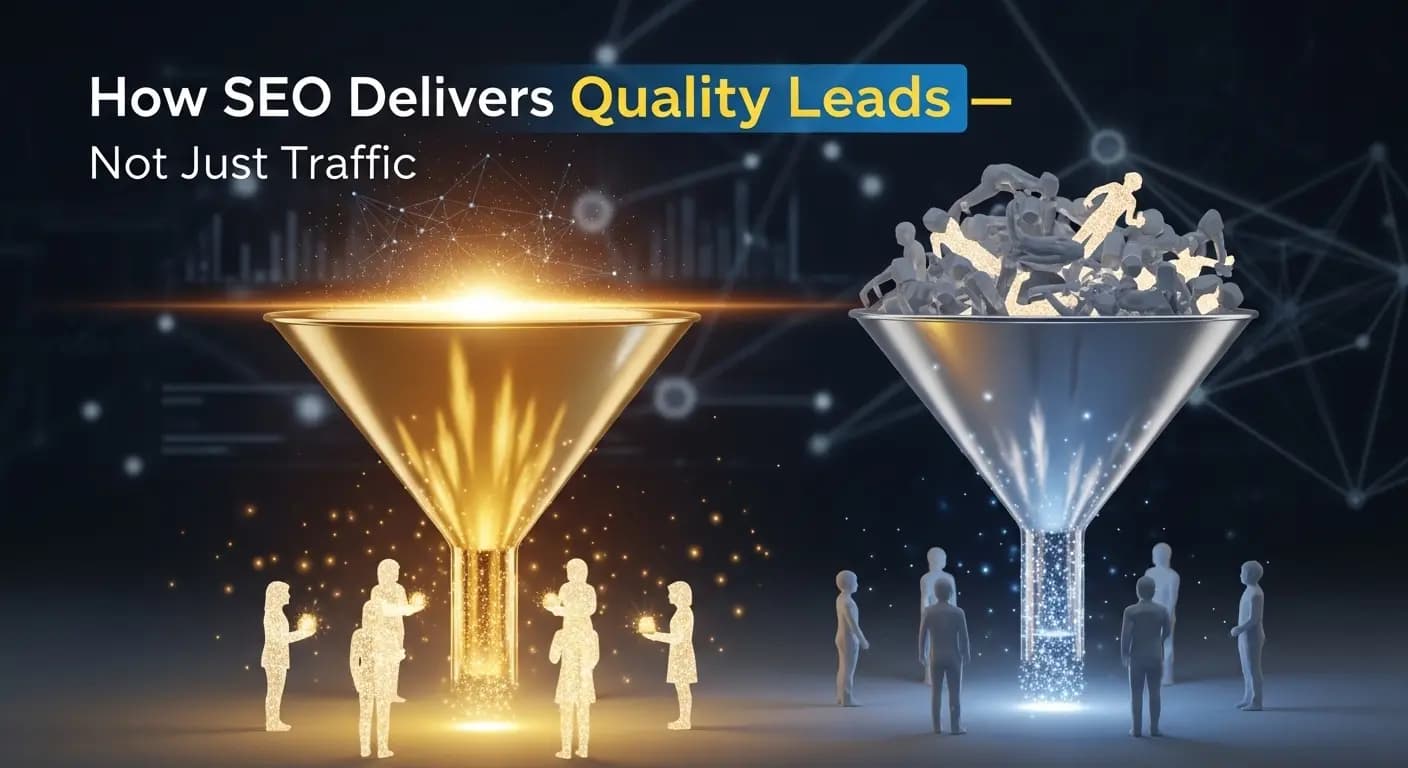
More website visitors sounds like a win. But if those visitors never buy, call, or enquire, you're just collecting numbers. The real power of SEO lies in attracting the right people — people who are actively searching for exactly what you offer.
There's a common misconception that SEO is simply about ranking higher on Google. While visibility is part of it, the true measure of a successful SEO campaign is the quality of the traffic it brings — and ultimately, the leads and revenue it generates for your business.
When someone types a specific query into a search engine, they're signalling intent. They're not passively scrolling through a social media feed — they're actively looking for a solution. SEO positions your business directly in front of those high-intent users at the exact moment they need you.
Why not all traffic is created equal
Paid advertising can drive large volumes of visitors to your site quickly, but the moment you stop paying, the traffic stops. Social media can build brand awareness, but audiences are passive. SEO, by contrast, earns you a consistent stream of users who are already searching for what you sell.
This is the core of why organic search leads convert at significantly higher rates than almost any other channel. The user has self-qualified. They found you because they were looking — not because an algorithm placed you in front of them.
The best lead is one that finds you. SEO is how that happens at scale, consistently, without paying per click.
The building blocks of a lead-generating SEO campaign
A well-structured SEO strategy that drives quality leads is built on several interconnected pillars. Each one contributes not just to ranking higher, but to attracting and converting the right audience.
- Intent-focused keyword research — finding the search terms your actual customers use, not just high-volume phrases, ensures you attract visitors with genuine purchase intent.
- Content that answers real questions — creating pages that directly address what your customers are searching for builds trust and moves users further down the funnel.
- A fast, crawlable website — site speed, mobile compatibility, and clean architecture allow search engines to properly index your pages and keep users from bouncing.
- Link building and digital PR — earning links from credible sources signals authority to Google, lifting your rankings for the terms that matter most to your business.
- Optimising for enquiries, not just visits — good SEO goes hand-in-hand with conversion rate optimisation to turn visits into actual leads.
- Measurable, transparent reporting — understanding which keywords, pages, and channels are driving real enquiries lets you refine strategy and prove return on investment.
SEO as a long-term business asset
One of the most underappreciated aspects of SEO is that its value compounds over time. Unlike paid campaigns that stop delivering the moment you pause your budget, well-executed SEO builds a permanent asset — a website that ranks, attracts, and converts around the clock.
A business that invests consistently in its organic search presence builds a competitive moat. Rankings take time to establish, but once achieved through ethical, sustainable methods, they are difficult for competitors to displace quickly. You're not renting visibility — you're earning it.
This is particularly important for businesses looking to reduce dependency on paid advertising spend, lower cost-per-lead over time, and build genuine brand authority in their market.
What good looks like: a targeted approach
The most effective SEO campaigns are those built around a deep understanding of your target customer — their language, their pain points, the questions they ask before making a buying decision. Rather than chasing broad, high-competition keywords, a targeted strategy focuses on capturing users who are closer to a purchasing decision.
This might mean optimising for location-specific searches if you serve a regional market. It might mean creating detailed service or product pages that answer specific pre-purchase questions. Or it might mean building a content hub that positions your brand as the authoritative resource in your niche.
The result isn't just more traffic — it's better traffic. Visitors who stay longer, explore more pages, and are far more likely to pick up the phone or fill in a contact form.
A targeted SEO strategy doesn't cast the widest net — it casts the right one.
Choosing the right approach for your business
For many businesses, the challenge isn't understanding the value of SEO — it's finding the time and expertise to execute it consistently. Keyword research, technical audits, content creation, link outreach, and performance tracking are each significant disciplines in their own right.
Whether you manage SEO in-house or work with a specialist agency, the principles remain the same: focus on your customer's intent, build genuine authority, and measure what matters — leads, enquiries, and revenue — not just rankings and pageviews.
Done well, SEO isn't a cost. It's one of the highest-returning marketing investments a business can make.